
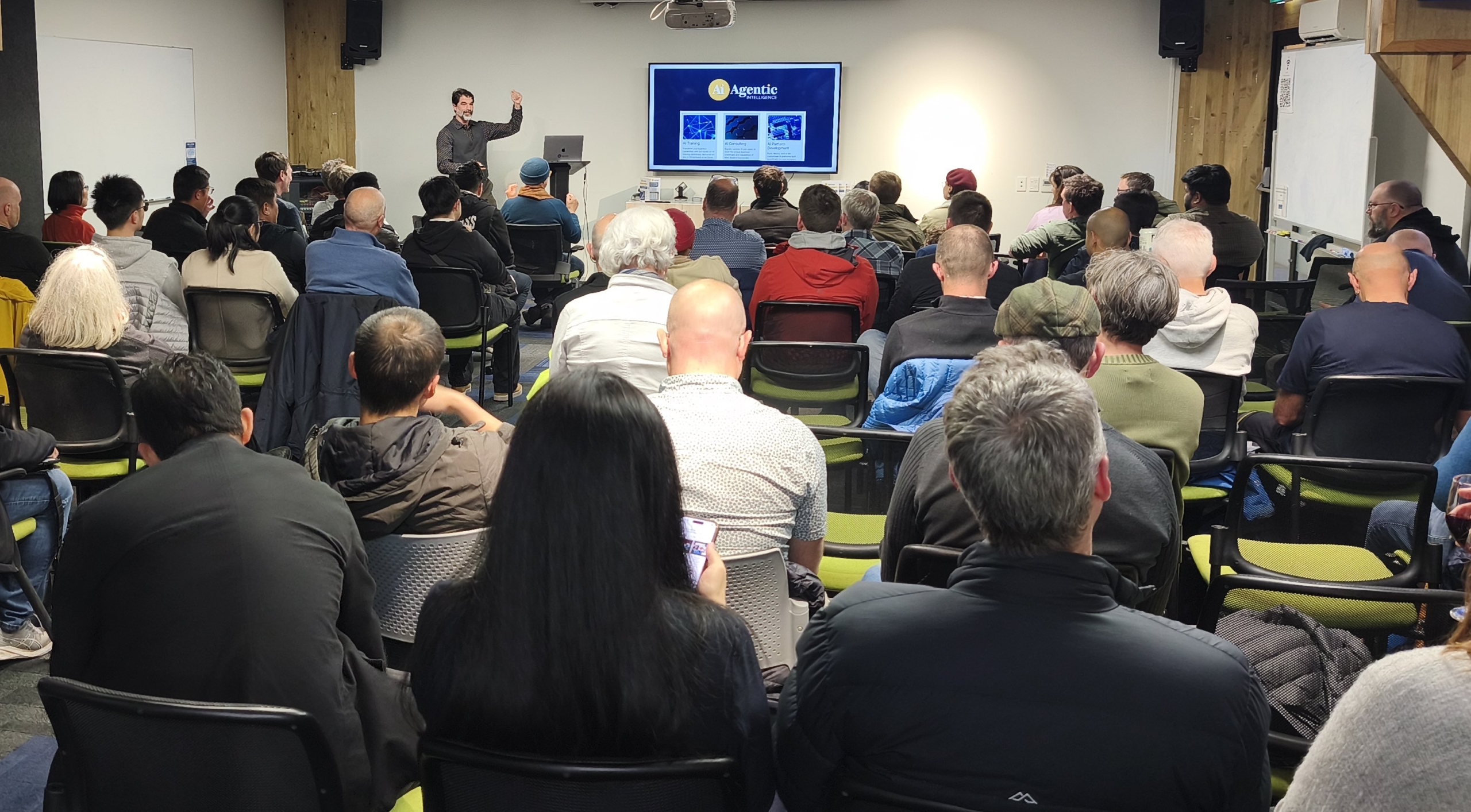
For 2026, my word is Teach.
The focus of my year will be teaching. Last year’s pivot into Ai helped my identify my Ikigai.
- It’s what I love doing (performing)
- That the world needs (education about Ai)
- And the world will pay for (experience using it)
- That I do well (creating a synthesis of complex information)
Teaching people how to use artificial intelligence – it’s my bliss right now. So I’m optimising everything in my life to grow this bliss.
I’m launching the Ai-Coaching.Academy in a few weeks. It’s a Mighty Network community for Ai operators who want to learn how to coach Ai to improve, and be coached in return, in the style of authors or mentors that have already helped them to grow.
As I grow this community, and develop my career as an Ai trainer, I want this word – Teach – to guide me back to my purpose. So I don’t forget: I’m here to teach. Not to grow the community, or to sell workshops, or to publish a series of content, but ultimately, I am here to help people to grow.
I’ve kept this as my guiding light for this year’s resolutions – which habits can best support me in the big 3 goals I have this year? (Big 3 Goals are down below the Resolutions.)
I have transcended many resolutions from years past. I don’t need to set a resolution to go to the gym, for example, because I’ve already baked in twice-a-week attendance into my schedule. It’s so rewarding and fulfilling, I no longer need the resolution to keep the habit.
Many of the potential resolutions I considered this year (daily morning routine, daily evening routine, track my health symptoms in an app on my phone whenever I sit on the throne, etc) are being tracked in a dashboard in one of my planners. So I can track it there, and if I keep my resolution to diligently use my tracking dashboard, then I am resolving to track it, not to do it. That distinction helps me focus the power of resolutions on a place where it can do the most good.
Last year, I didn’t resolve to do my entire one-hour morning routine, I resolved to do the second part of it: 6 sun salutations. That was my resolution. So even on mornings where I skipped my morning routine (because of laziness or schedule conflicts) I could still do this one small piece, keep my resolution, and maybe get the momentum to do the whole thing (this happened plenty of times).
I make my resolutions positive, because you can’t do a don’t.
I also focus on the tiniest of habits because, as Chris Brogan said in his newsletter last week, “Your day is your week is your month is your year.”
New Years Resolutions 2026
Screens Off by 8 PM
This is one of those micro-habits that has a lot of downstream effects. I’ve got an alarm set for 8pm on my phone called ‘Gratitude Journaling,’ but I ignored it for most of 2025. However, what the alarm did is alerted me that it was time to wrap up what I was doing, go do the dishes, and make some chamomile tea.
So now, that’s the first part of my eventing routine. Make tea, and do the dishes, while coconut oil pulling. This week, I set up a new multi-timer, that guides me through 10 minutes to read a book in my reading chair, 10 minutes to journal about my day in my diary, 10 minutes to pray at my altar, and 10 minutes to do qi gong or stretch in my bedroom. This puts me in bed reading a big thick fantasy fiction book by 9pm, which reliably gives me good sleep, which has plenty of other downstream effects.
My resolution isn’t t do the whole evening routine (if I broke it too much I might give up, and I would feel obligated to keep it as-is instead of changing it as needed) but instead, I am just resolving to turn screens off when my 8pm alarm goes off.
Diligent Dashboards
How often do I do this evening routine? How often do I do all the activities in my morning routine? I like tracking these activities in little tickbox grids in my planners. Instead of resolving to do this or that for the whole year, I just resolve to track my activity diligently. This gives me the flexibility to discard or modify habits mid-year; I just need to regularly review the scoreboard.
I mean, I’m the guy who wrote the ebook on how to Gamify Your Work. Keeping score lets me allocate rewards, and incentivise the activity I want.
Award Myself the Reward
One of the things I like about my planners is that there are sections for goals for the month, the week, and the day – and each of them has a little companion box that says, ‘Reward if achieved’. I often attain a goal, and don’t take the time to award myself the reward I had decided for myself.
This year, I resolve to be good about awarding myself the reward – and while enjoying it, to savor the satisfaction of achieving my goal, and feel gratitude for its accomplishment.
Monthly Family Dates
Every month, I want to take someone out 1-on-1. I’ve got 3 kids and a wife, and there are 4 weeks in a year, so in shorthand, every weekend I’m going to go do something fun as a duo. This is the only christmas where all three of my kids are teens, and while we have a family movie night and a family game night, I want more one-on-one time with them before they are fully grown.
Big 3 Goals for 2026
I’ve spent many happy hours this past week in introspection, planning, and goalsetting. This has given me the perfect grounding for setting my New Year’s Resolutions today.
I have a number of notebooks at the moment, all with different purposes. One of them is published by Darren Hardy, called ‘Living Your Best Year Ever.’ Hardy is the CEO of Success Magazine, and sits in the chair once occupied by W. Clement Stone, Napoleon Hill, and Og Mandino, all authors of books that have had a profound impact on me. Working with Hardy’s goalsetting planner has been fantastic. It’s helped me clarify my 3 biggest goals for the year:
- $30k Monthly Revenue
- Publish a Book
- 100 Paying Members
If I can accomplish these 3 goals, I will count this year a success. I’ve designed my New Year’s Resolutions with these 3 goals in mind, and built habit and accountability structures that lead to these 3 goals.
I like the clarity of a small number of goals, because, as Steve Jobs once said, “People think focus means saying yes to the thing you’ve got to focus on. But that’s not what it means at all. It means saying no to the hundred other good ideas that there are.”
Identifying these 3 goals has served as a filter. One of my potential resolutions was to earn 10 travel fees – have 10 different clients pay for my travel to speak or teach somewhere. But then I realised, I would be optimising for the wrong thing. The advantage of having a multimedia studio in my home, and the ability to deliver training workshops via webinar (where the copy/paste of Ai prompts is so much easier to facilitate than in in-person workshops) means that I would actually be better served this year by focusing on building my community, writing my next book, and generating the revenue I want. Too much travel could actually get in the way of that, so I won’t pursue that goal very strongly.
The reward I plan to give myself for reaching a $30k run rate (an average of $30k in revenue over 12 months, or $360k generated within 1 year) is to re-join Thought Leaders Business School. I was in that program for 3.5 years, and I loved having a community of peers who make a living sharing their ideas.. I couldn’t find the right topic, though, and I kept stumbling around the lower belts. If I can get to Green Belt, then joining Thought Leaders will likely help me get to Black Belt ($60k/month) quickly. That’s my 2027 goal.
But first, 2026.
I’m very optimistic about this year.
To see yesterday’s Annual Review of 2025, click here.
To read all of my New Year’s Resolutions, click here.





You are amazing and Inam so impressed. 2026 is going to be fantastic— and fun! Well done.